

Leadership does not change on the periphery, but at its core.
In a working world that is simultaneously under strain from technological, economic, and social pressures, it is no longer enough to treat leadership merely as a cultural or human resources issue. The key question is: What form of leadership actually enables organizations to remain effective and high-performing in the face of AI, skill shifts, regulatory complexity, BANI dynamics, and rising employee expectations? Which leadership model ensures that organizations can continue to act effectively and succeed in a brittle, anxious, nonlinear, and incomprehensible world?
With this systematic shift, leadership is once again becoming critical to success. So far, nothing new. Leadership has always been a business-critical factor for value creation, adaptability, and future viability. But amid one of the most critical economic upheavals of recent decades, it is no longer enough to describe leadership in normative terms. More urgently than ever, HR must answer the central question of how leadership contributes not only to satisfaction, retention, or culture, but also: What concrete and demonstrably measurable contribution does leadership make to productivity, the speed of transformation, quality standards, decision-making capabilities, and thus to actual business results?
Which Competency Clusters Will Shape Leadership and Leadership Performance Management Systems in 2030
This also means radically rethinking leadership performance management: making it more digital, data-driven, and consistent. However, any leadership performance system is worthless if it measures the wrong things or is focused on the wrong factors. This is precisely where the real challenge begins. Performance and Leadership Value Contribution (LVC) can only be reliably developed and measured when the underlying understanding of leadership is described in a way that is future-proof and validated.
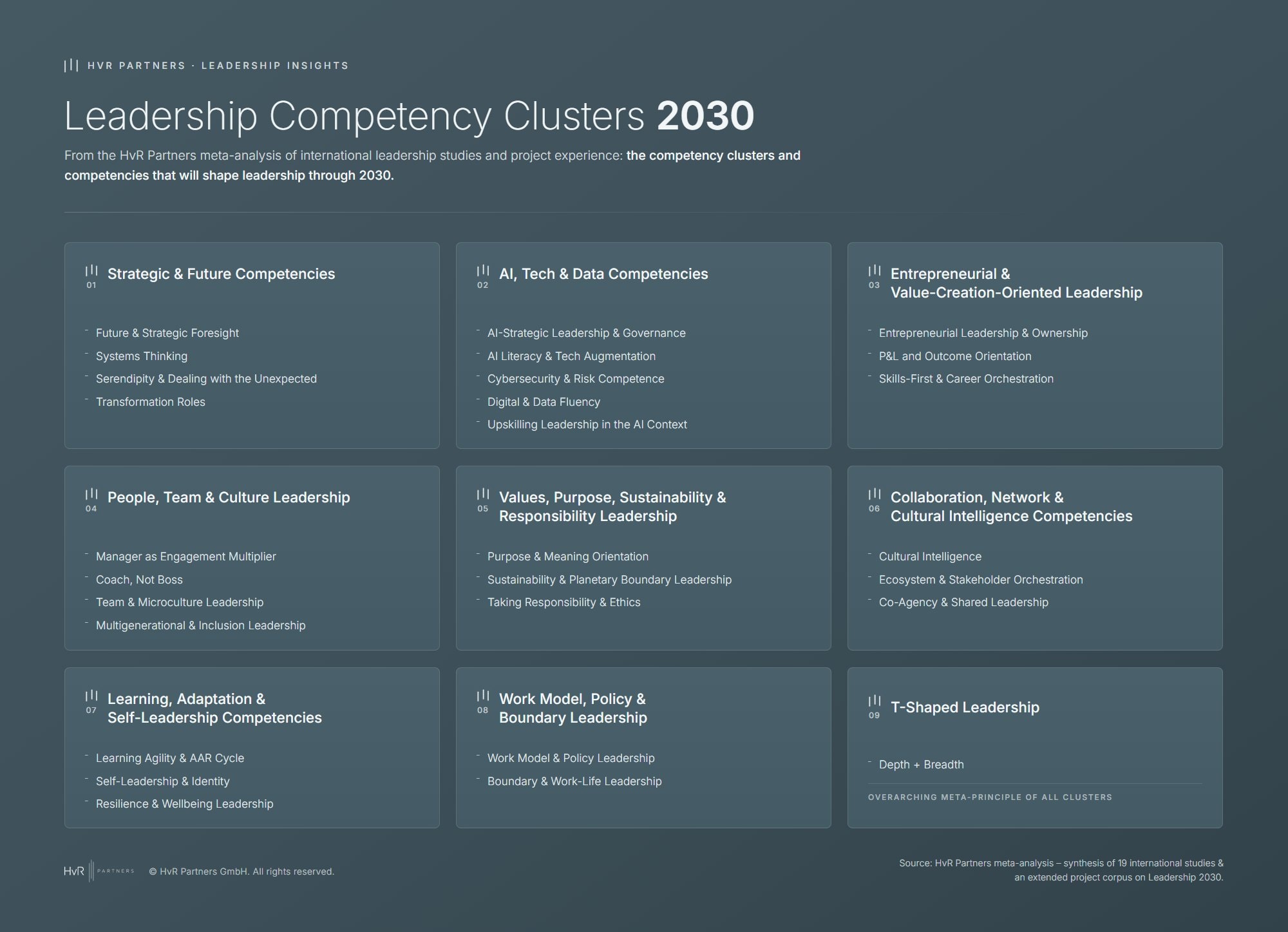
This is exactly where HvR Partners’ meta-analysis comes in. It synthesizes international studies, research papers, future analyses, and project experiences into a coherent framework that reveals which competency clusters and specific competencies will shape leadership by 2030—and how their emphasis shifts across different leadership levels. In our meta-analysis, we have brought together 19 international research papers, studies, and future analyses, as well as an extensive body of project data, and synthesized them into a forward-looking leadership model. What was decisive here was not so much the number of individual future skills as the underlying meta-structure: the connection between the environmental demands placed on organizations in 2030 and the expectations of teams and employees in 2030.
In the meta-analysis, Leadership 2030 is grouped into nine competency clusters comprising 28 specific competencies:
HR Must Become a Value Architect
If Leadership 2030 is understood through this lens, the role of HR will also undergo a fundamental transformation. HR will then not only design learning journeys, but also the architecture that enables leadership to be effective, adaptable, and measurable in the first place: from competency models and skill frameworks to development, succession, and performance systems.
From an HvR perspective, being a Value Architect means not treating leadership as an isolated area of training. It’s about linking leadership quality with business priorities, role architecture, workforce planning, learning investments, and cultural dynamics. This requires experts who are skilled in both—systems and people.
This becomes particularly relevant when it comes to AI. Companies are currently investing in technologies, processes, and productivity. However, far too rarely do they consistently determine what leadership behaviors, management logic, and development architecture are necessary to achieve this. It is precisely this gap that will determine success or failure in the coming years.
The point isn’t to keep declaring leadership the key success factor at every management meeting. The key question is: How quickly can we finally shift our perspective on leadership from an important—but too narrow—human resources development lens to an effective management and value-creation system with data-driven integration into the value chain? In our view, this requires four clear priorities:
- Redefining leadership through a few business-relevant competency clusters rather than seemingly complex ideal profiles
- Differentiating the competency framework by management level and functional area, without creating separate worlds or silos
- Consistently positioning HR as a Value Architect that integrates skill, leadership, and performance architectures in a data-driven and measurable way
- Development of a leadership performance management system that transparently measures and manages leadership quality in terms of business impact, transformation success, and impact on people
What emerges here as a competency cluster is more than just a roadmap of future leadership requirements. Let’s view it as an invitation to rethink leadership in your organization.
Things get particularly interesting where these competencies are differentiated by management level. We look forward to the discussion—whether on individual topics or on the complete, level-differentiated model.